
Self-hosted LLM deployment for production workloads
Run a self-hosted LLM on infrastructure you control. We select the model, build the serving layer and add the monitoring and access controls that production systems need.
Book an architecture callSee the ARIA case study Ollama
 Hugging Face
 Llama by Meta
 Mistral AI
 Docker
 Kubernetes
What is a self-hosted LLM?
A self-hosted LLM is a large language model that runs on servers you control, rather than through a third-party API. That may be a dedicated cloud account, a private data centre or on-premises hardware.
Self-hosting gives more control over data, model versions and running costs. It also makes you responsible for capacity, reliability and upgrades, so the decision should be based on your actual workload.
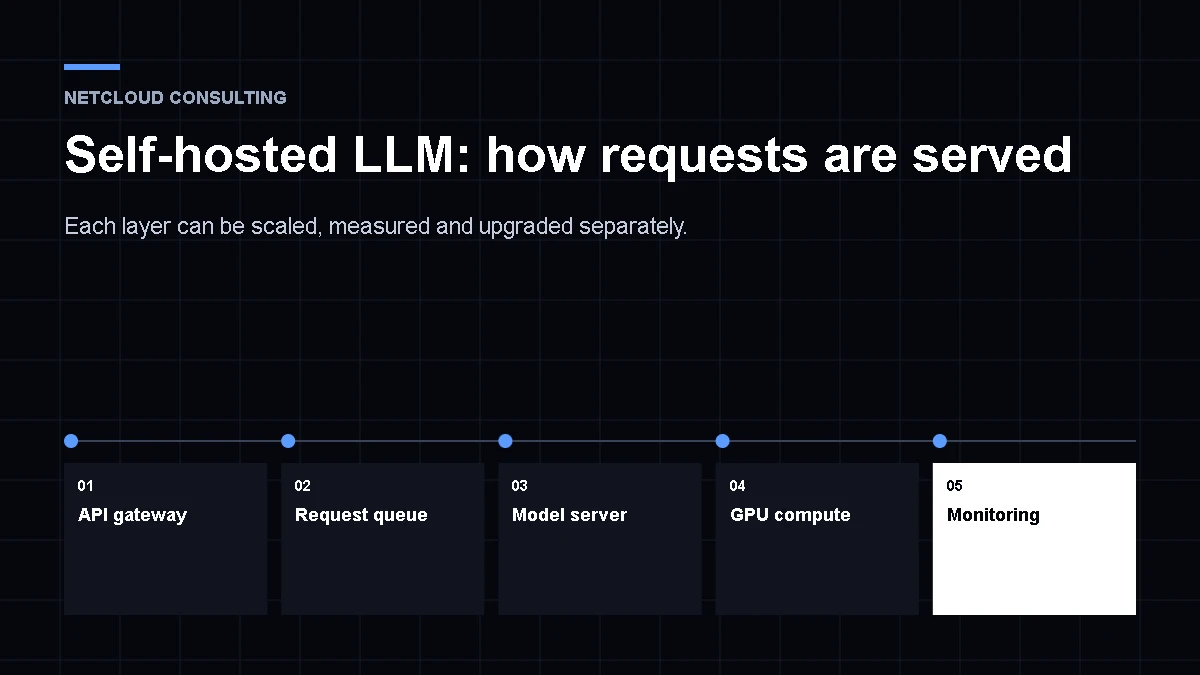
Our self-hosted LLM services
From a first proof of concept to a monitored service used by your applications and agents.
Model selection
Shortlist models against your tasks, languages, hardware and licence requirements.
Compare open models →Serving layer
Use Ollama for simple, low-concurrency setups or vLLM for higher-concurrency production serving.
Capacity planning
Estimate memory, GPU and concurrency needs from expected traffic and response targets.
Plan GPU capacity →API compatibility
Expose an OpenAI-compatible endpoint so applications can switch with few code changes.
Security controls
Add private networking, authentication, rate limits and audit logging.
Private deployments →Quality monitoring
Track latency, throughput, errors and answer quality after every model change.
Ollama, vLLM or a frontier API?
Ollama
Best forLocal work, internal tools and low concurrency
Watch forLess suited to many simultaneous production users
vLLM
Best forMulti-user production serving on supported GPUs
Watch forMore tuning and infrastructure knowledge required
Frontier API
Best forHard reasoning and uneven demand
Watch forData terms and per-token cost at high volume
How we deploy a self-hosted LLM
A staged rollout proves quality and cost before you commit to larger capacity.
Baseline
Collect real prompts and agree targets.
Benchmark
Test shortlisted models on your data.
Build
Deploy serving, gateway and security.
Load test
Measure latency at expected concurrency.
Operate
Monitor quality, capacity and upgrades.
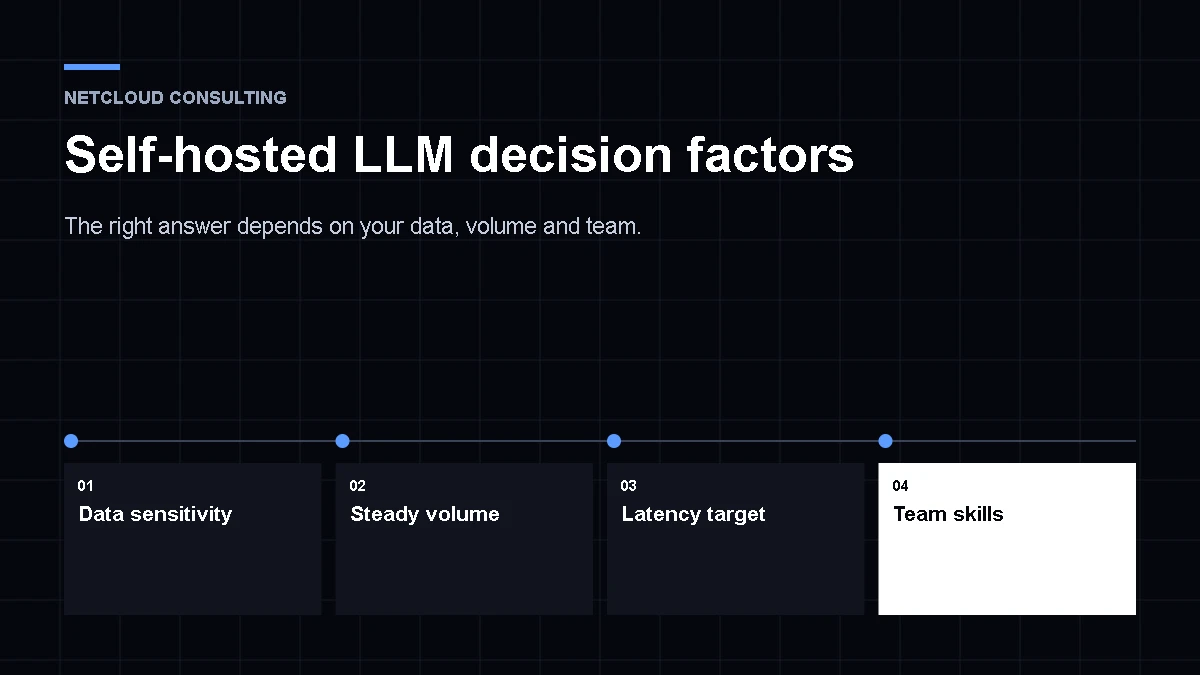
Self-hosted LLM buyer checklist
Measure before choosing hardware
A self-hosted LLM should be sized from real traffic. Record typical prompt length, response length and peak concurrent users. These measurements decide memory and GPU needs far better than a generic hardware recommendation, and they prevent both overspending and poor response times.
Plan the serving layer
Ollama is quick to set up and works well for development and small internal tools. vLLM is built for many concurrent requests. Whichever you choose, place an authenticated gateway in front so that applications do not connect directly to the model server.
Test upgrades safely
New model versions can improve one task and damage another. Keep a saved test set from your real work, run each candidate through it, and release upgrades gradually. Keep the previous version available, so that you can roll back quickly if quality drops.
Keep a frontier option
Self-hosting does not need to be all or nothing. Many teams keep routine and sensitive work on hosted models, then use a frontier model for unusually hard reasoning. Routing rules and logging keep that choice deliberate, measured and easy to review.
Official resources: Ollama, vLLM documentation and Hugging Face model hub.
Self-hosted LLM questions
Is a self-hosted LLM cheaper than an API?
It can be at steady, high volume. At low or uneven volume, an API is often cheaper once GPU and operations costs are counted. We model both using your expected usage.
Which is better, Ollama or vLLM?
Ollama is simpler and works well for development and small workloads. vLLM is generally the stronger choice for production serving with many concurrent users.
Can a self-hosted LLM run without internet access?
Yes. Once models and dependencies are installed, the service can run on a private or isolated network.
Have you deployed this in production?
Yes. Our ARIA voice tutor uses a hosted Qwen model on Ollama, reachable only on a private network, with frontier models available as an option.
Related AI infrastructure and services
Plan your self-hosted LLM
Share your use case and expected volume, and we will recommend the simplest deployment that meets your targets.
Talk to our AI infrastructure team