
Qdrant vector database deployment and tuning
Give your AI agents fast, accurate retrieval. We design, deploy and tune the Qdrant vector database for RAG systems, with filtering and access rules built in from the start.
Book an architecture callSee the ARIA case study Qdrant
 Ollama
 LangChain
 Docker
 Kubernetes
 n8n
What is the Qdrant vector database?
Qdrant is an open-source vector database built for similarity search. It stores embeddings together with metadata, so applications can find content by meaning while applying filters such as customer, language or permission.
Its core can be self-hosted, which suits private AI projects. Qdrant also offers managed and hybrid cloud options. We help you choose a deployment model and configure it for your data.
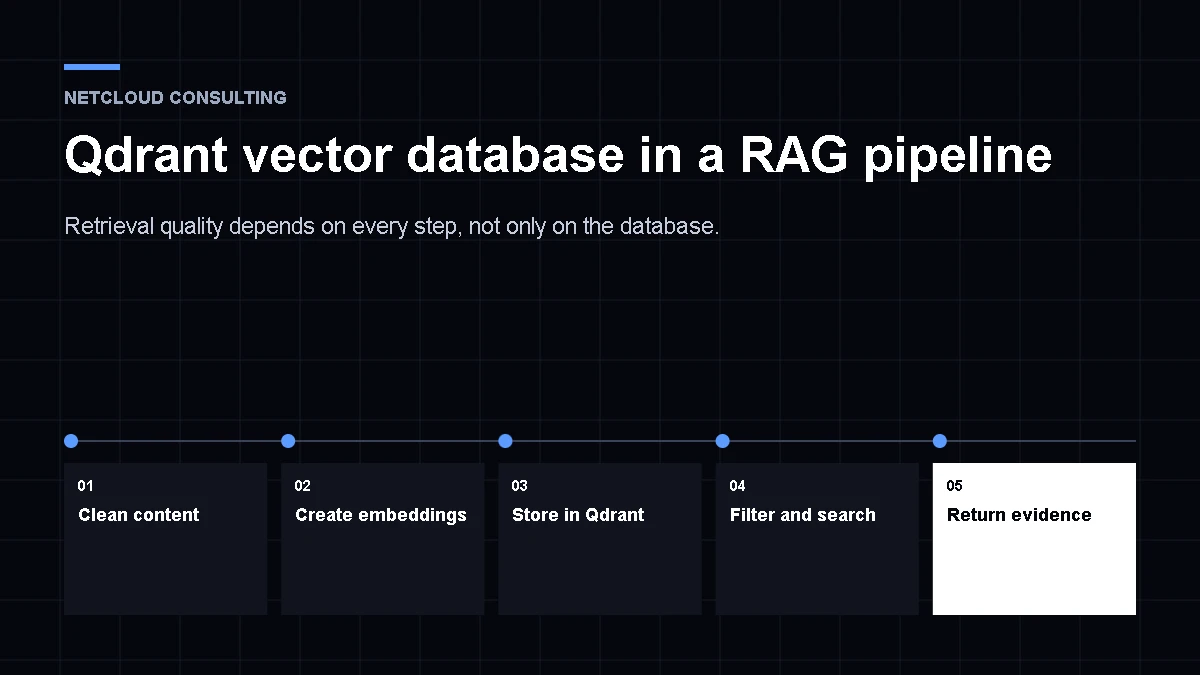
Our Qdrant vector database services
Design decisions made early prevent costly re-indexing later.
Collection design
Plan vectors, payload fields, filters and multitenancy for your data.
Embedding selection
Choose and test embedding models using your own questions.
Hybrid search
Combine dense and sparse vectors for better results on exact terms and meaning.
Performance tuning
Tune indexing, quantisation and memory for your speed and recall targets.
High availability
Plan replication, sharding, backups and recovery for production.
Permission filtering
Apply access rules during retrieval so users see only allowed content.
RAG infrastructure →Which Qdrant deployment fits?
Self-hosted
Best forPrivate data and teams able to operate it
Watch forYou own upgrades, backups and scaling
Hybrid cloud
Best forData in your environment with vendor-managed operations
Watch forCheck commercial terms and network design
Managed cloud
Best forFast start with less operations work
Watch forConfirm data location and security needs
How we implement Qdrant
We measure retrieval before tuning, so that changes can be judged objectively.
Audit
Review content and access rules.
Design
Model collections and metadata.
Index
Load data and create embeddings.
Evaluate
Measure retrieval on real questions.
Harden
Add backups, monitoring and security.
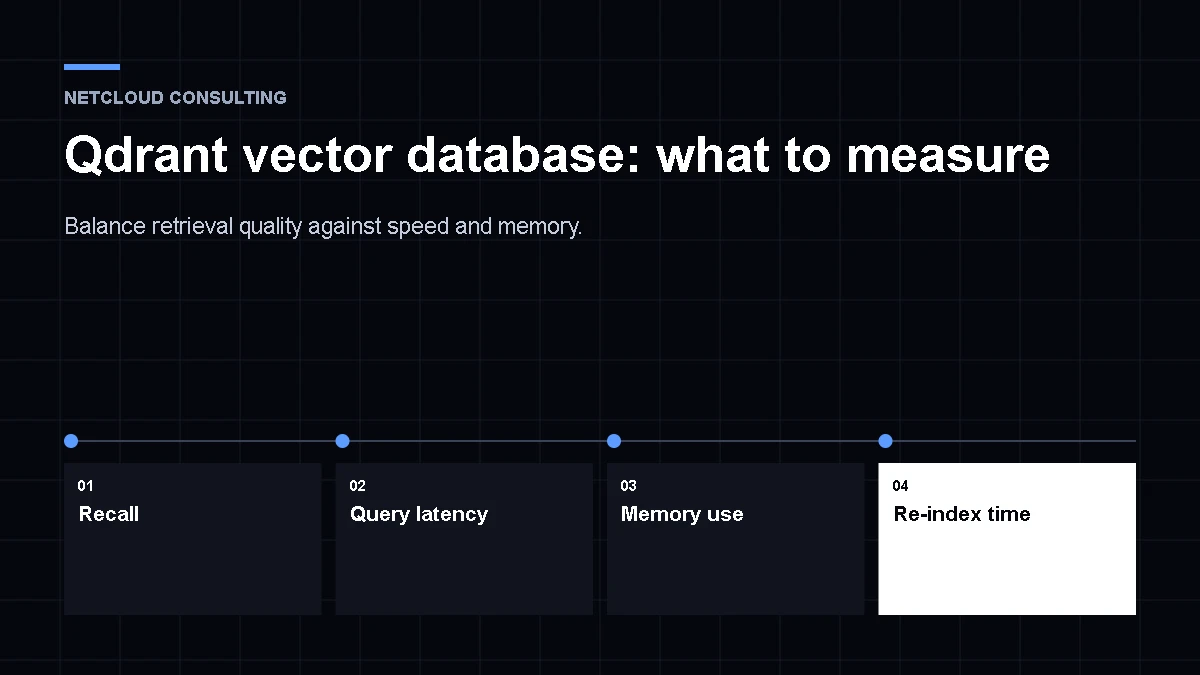
Qdrant vector database design guide
Design metadata early
Metadata decides what a Qdrant vector database can filter on later, such as customer, language, date or permission. Adding fields afterwards can mean reprocessing data, so list the filters your applications and access rules will need before indexing begins.
Choose embeddings carefully
Embedding quality often affects results more than database settings. Test models on real questions in your languages. Changing the embedding model later means re-embedding your content, so include that time and cost in the plan.
Balance memory and accuracy
Quantisation can reduce memory use substantially but may affect retrieval quality. Measure recall and speed together on your own data, then choose settings that meet your target. Different collections may need different trade-offs, depending on how they are used.
Plan multitenancy and recovery
If several clients or teams share a system, decide how their data is separated and test it. Add scheduled snapshots and practise restoring them. A vector index can often be rebuilt, but rebuilding at scale takes time you may not have.
Official resources: Qdrant documentation, Qdrant on GitHub and pgvector.
Qdrant vector database questions
Is Qdrant open source?
Yes. Its core engine is open source and can be self-hosted. Managed and private-cloud options are commercial services, so check current terms for your deployment.
Does Qdrant support hybrid search?
Yes. It supports combining dense and sparse vectors, which helps queries that depend on exact product codes or terms as well as meaning.
Do you use Qdrant in production?
Yes. Our ARIA voice tutor uses self-hosted Qdrant to find the most relevant study notes for each question.
Should we use Qdrant or our existing database?
If you have a modest dataset and already use PostgreSQL, pgvector may be enough. A dedicated engine such as Qdrant suits larger or more demanding retrieval. We compare both using your workload.
Related AI infrastructure and services
Improve your retrieval
Share a sample of your data and questions, and we will review your vector search design.
Talk to our AI infrastructure team