
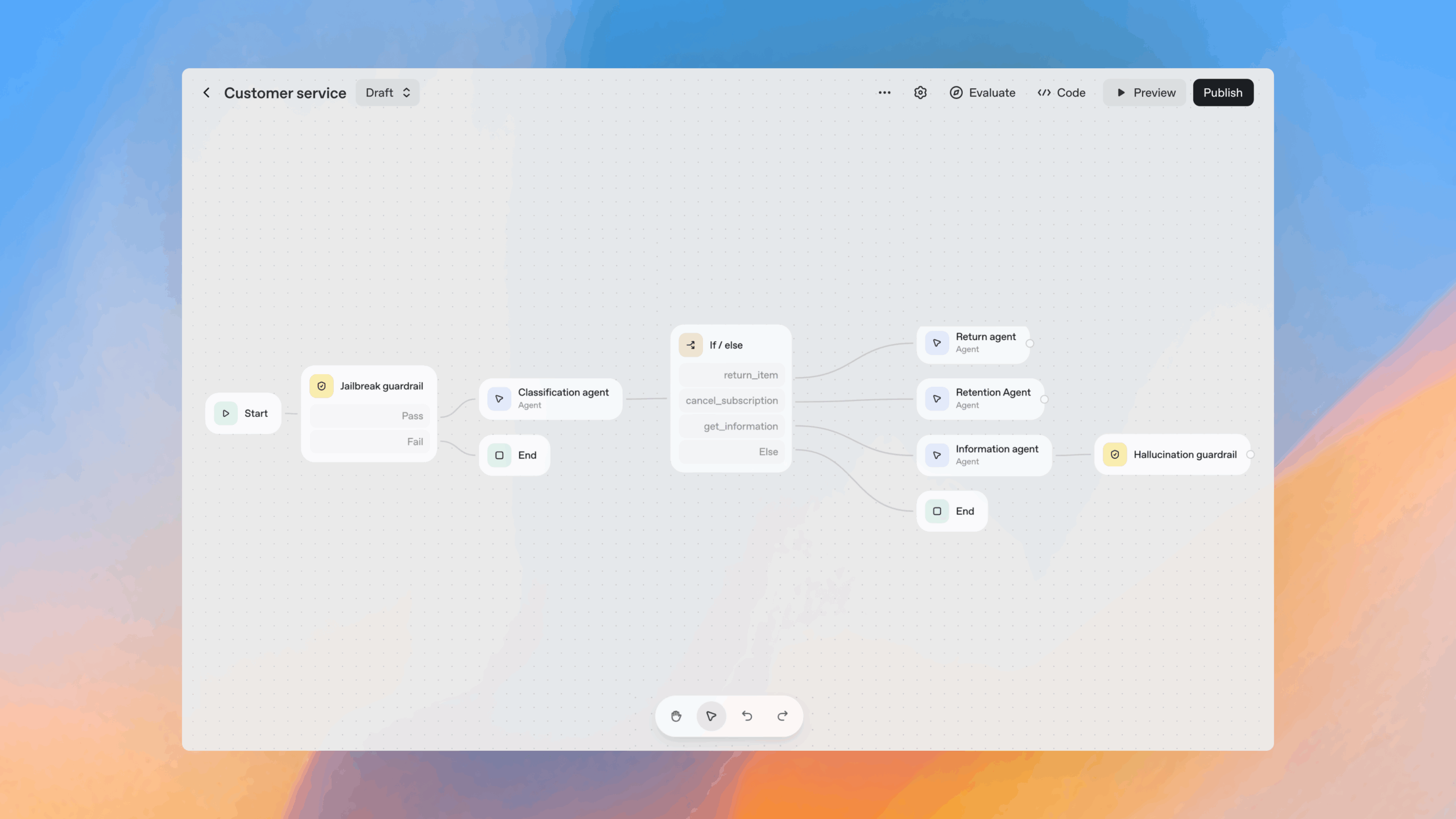
From Workflows to Thinking Systems: The Rise of AgentKit in Business Automation
The Shift from Automation to Autonomy
For years, businesses have been chasing automation — setting up workflows, triggers, and integrations to make repetitive tasks disappear. Platforms like Zapier, Integromat, and n8n changed the way teams worked, turning manual processes into sequences of “if this, then that.”
But in 2025, something remarkable is happening. The world of automation is evolving — from rule-based workflows to autonomous, thinking systems that don’t just execute instructions, but reason, adapt, and decide.
This evolution is powered by AgentKit — a new layer of intelligence that’s turning static automations into agentic systems capable of understanding context, making judgments, and continuously improving.
Welcome to the age where workflows learn to think.
1. The Problem with Traditional Automation
Traditional automation is powerful but limited. Every action depends on pre-defined triggers and rigid rules. For example:
A lead fills out a form → Add to CRM → Send a welcome email.
An order is placed → Update inventory → Notify dispatch team.
These workflows are deterministic — they work perfectly until something unexpected happens:
The lead’s email looks suspicious.
The order comes from an unfamiliar region.
The API call fails due to a network error.
In each case, the system doesn’t understand what went wrong — it just fails. Humans have to step in.
Automation, therefore, becomes a brittle efficiency tool — fast, but fragile. It’s like hiring an employee who follows instructions perfectly but can’t think for themselves.
2. Enter AgentKit: The Brain Behind the Workflow
AgentKit changes that.
It’s not just an automation framework — it’s an intelligence layer that sits between your data, APIs, and business logic, enabling workflows to reason, reflect, and act dynamically.
Instead of “if this, then that,” AgentKit enables “if this, what should I do — and why?”
The Core Idea:
AgentKit brings the power of Large Language Models (LLMs) — like GPT, Claude, Gemini, or DeepSeek — into the heart of automation. Each agent becomes a decision-maker equipped with memory, context awareness, and reasoning capabilities.
It’s the bridge between automation and autonomy.
3. What Makes AgentKit Different?
Let’s break down how AgentKit transforms workflows into thinking systems.
| Capability | Traditional Automation | AgentKit Approach |
|---|---|---|
| Logic | Fixed “if-then” rules | Dynamic reasoning based on context |
| Error Handling | Manual exception resolution | Self-healing, tries alternate strategies |
| Adaptability | Requires human updates | Learns from previous outcomes |
| Communication | Sends pre-written messages | Generates adaptive, context-aware responses |
| Scalability | Limited by human maintenance | Self-improving, scalable across domains |
AgentKit empowers automations to interpret ambiguous inputs, take corrective actions, and even collaborate with other agents for complex tasks.
4. How It Works: The Anatomy of an Agent
Every Agent inside AgentKit operates with three essential pillars:
1. Reasoning Core (The Brain)
This is powered by LLMs. It interprets the task, analyzes the context, and decides the best next action.
Example:
Instead of “send response,” the agent evaluates tone, urgency, and customer intent before composing a personalized reply.
2. Memory Layer (The Consciousness)
Traditional automations forget everything after execution. AgentKit introduces short-term and long-term memory, so agents can recall past interactions, outcomes, or even customer preferences.
Example:
If a client asked for a “discount policy” last week, the agent remembers and automatically shares the latest policy version the next time.
3. Action Layer (The Hands)
Once a decision is made, the agent uses APIs, CRMs, or connectors (like n8n, Zapier, or custom webhooks) to act.
AgentKit integrates seamlessly with existing workflows — so your systems don’t need a rebuild.
5. Real-World Use Cases: When Agents Start Thinking
1. E-commerce and Marketplace Operations
Dynamic product listing optimization: Agents analyze keyword trends, competitor titles, and reviews to auto-suggest improvements.
Order issue resolution: When an order delay occurs, the agent autonomously emails the vendor, updates the customer, and checks refund eligibility.
2. Sales and CRM
Lead prioritization: Instead of assigning leads blindly, AgentKit evaluates intent, behavior, and likelihood of conversion.
Follow-up intelligence: It crafts personalized emails based on deal stage and conversation tone.
3. Support and Service Automation
Intelligent triage: Agents read inbound emails or WhatsApp chats, categorize issues, and draft contextual replies.
Continuous improvement: Each resolved ticket teaches the system how to handle similar cases better next time.
4. Internal Operations and HR
Employee onboarding: Agents personalize onboarding workflows, reminders, and FAQs.
Performance tracking: They summarize employee reports, flag anomalies, and suggest improvements.
Each use case reduces manual dependency while improving quality, accuracy, and adaptability.
6. Why Businesses Need Thinking Systems Now
The business world is evolving faster than ever. Customers expect personalized, real-time interactions. Markets shift overnight. APIs change without warning.
In this chaos, static workflows simply can’t keep up.
Businesses need thinking systems that can:
Interpret complex data in real time.
Make contextual decisions instead of rigid ones.
Learn continuously from outcomes and feedback.
In short, they need systems that can understand, decide, and act autonomously — which is exactly what AgentKit enables.
7. AgentKit in Action: A Day in the Life of an Autonomous Workflow
Let’s take an example of an intelligent marketplace management system powered by AgentKit — something Netcloud Consulting builds for clients across e-commerce platforms.
Morning: The system detects slow-moving SKUs on Amazon.
Agent 1 (Analyst Agent): Analyzes price trends, competitor listings, and reviews.
Agent 2 (Optimizer Agent): Suggests better product titles, keywords, and discounts.
Agent 3 (Communicator Agent): Updates changes via WooCommerce API and notifies the seller.
Agent 4 (Reporting Agent): Summarizes the day’s performance with insights and improvement ideas.
No human intervention required.
Yet every decision feels intelligent, contextual, and business-aware.
This is not the future — it’s happening right now with AgentKit.
8. Integrating AgentKit with Your Existing Stack
You don’t need to throw away your current tools to go agentic.
AgentKit integrates beautifully with existing ecosystems:
n8n, Make, or Zapier → for orchestration.
CRMs like HubSpot, Zoho, or Salesforce → for lead and data management.
LLM APIs like OpenAI, Anthropic, or DeepSeek → for reasoning.
Databases like MySQL, MongoDB, or Google Sheets → for memory storage.
This hybrid model — AgentKit as an intelligence layer over existing systems — makes it the most practical way for businesses to transition toward autonomy.
9. Why Developers and Tech Partners Love AgentKit
1. Modular Architecture
Developers can create and deploy independent agents for tasks like analysis, content creation, or decision-making — and combine them like Lego blocks.
2. API-First and Open Source Friendly
It’s flexible enough to integrate with any stack, whether you’re using Node.js, Python, or PHP backends.
3. Learning Systems Built In
Each agent can record its performance, learn from feedback loops, and improve through fine-tuned prompts.
4. Extendable Memory and Context
Developers can plug in vector databases (like Pinecone or Chroma) or use simpler storage systems for memory.
5. Partner Potential
Tech agencies can build custom vertical agents — e.g., HR agent, Finance agent, CRM agent — and resell them as white-label solutions powered by AgentKit.
10. How AgentKit Changes Business Outcomes
Before AgentKit:
Teams relied on static rules.
Errors required manual correction.
Insights were after-the-fact, not in real time.
After AgentKit:
Systems analyze, decide, and act autonomously.
Feedback loops enable continuous improvement.
Businesses move from “automated efficiency” to “intelligent growth.”
The shift isn’t just technical — it’s strategic.
Companies adopting agentic systems report:
40–70% faster process handling
25–50% reduction in manual intervention
Improved customer satisfaction through personalization
AgentKit brings AI cognition into every business decision.
11. Netcloud Consulting’s Vision: Where Commerce Meets Cognition
At Netcloud Consulting, we see AgentKit not as a tool — but as a foundation for the next era of intelligent commerce.
Our philosophy is simple:
“Automation saves time. Intelligence multiplies value.”
We’re using AgentKit to power systems that:
Monitor marketplace listings across Amazon, Flipkart, and Shopify.
Run self-optimizing ad campaigns.
Handle customer queries via WhatsApp AI agents.
Manage internal operations through performance-aware agents.
Every agent we deploy learns from data, improves with feedback, and operates in sync with business goals.
That’s the true meaning of commerce that thinks.
12. Future of AgentKit and Agentic AI
The coming years will see AgentKit evolve beyond single-agent models into multi-agent ecosystems where agents collaborate, negotiate, and even audit each other.
Imagine:
A Sales Agent negotiates pricing based on demand data.
A Marketing Agent generates new creatives and A/B tests them.
A Finance Agent reviews performance and reallocates budgets dynamically.
Together, they operate as a digital boardroom, constantly improving business outcomes without needing human micromanagement.
This is where the world is heading — and AgentKit is leading the way.
13. Challenges and Best Practices
Like all powerful technologies, adopting AgentKit requires strategy and discipline.
Key Challenges:
Data Privacy: Ensure sensitive data stays anonymized.
Prompt Engineering: Poor prompt design can lead to poor reasoning.
Governance: Define human oversight boundaries.
Best Practices:
Start with narrow, high-impact automations.
Build feedback loops into every agent.
Combine structured logic (n8n) with adaptive reasoning (AgentKit).
Track metrics like reasoning accuracy, fallback rate, and improvement over time.
Done right, AgentKit becomes your AI operations backbone.
14. The New Paradigm: Businesses That Think for Themselves
AgentKit represents more than an upgrade — it’s a paradigm shift.
It’s not about making machines smarter; it’s about making business systems self-aware, self-optimizing, and self-reliant.
Tomorrow’s winning companies won’t just automate tasks — they’ll delegate outcomes to intelligent systems that understand the bigger picture.
From workflows to thinking systems, from execution to cognition —
AgentKit is the bridge.
15. Key Takeaways
| Insight | Meaning for You |
|---|---|
| AgentKit brings cognition to automation. | Your workflows can now understand, decide, and adapt. |
| It works with your existing tools. | No rebuild required — just add intelligence. |
| It benefits both clients and tech partners. | Businesses get outcomes; partners get innovation. |
| It defines the future of intelligent commerce. | Netcloud Consulting is building the ecosystem now. |
We stand at the edge of a revolution.
AgentKit isn’t just the next tool — it’s the operating system for autonomous business intelligence.
With AgentKit, automation becomes self-aware.
Workflows become adaptive.
Businesses start to think.
And when your business can think — growth becomes inevitable.
AgentKit: key takeaways and resources
AgentKit marks a shift from fixed, step-by-step workflows to systems that can plan, use tools and adapt to new situations. For most businesses the best first projects are narrow and measurable: order support, lead qualification, catalog updates or internal knowledge search. Start small, measure accuracy and time saved, then expand.
For background, see this overview of intelligent agents. To build production agents for your company, explore our agentic AI development service and enterprise agentic workflows with n8n and LLMs.