
Open source AI models, tested on your real work
Open source AI models offer more control and deployment choice. We help you select, evaluate, fine-tune and run the right model instead of relying on leaderboard scores alone.
Book an architecture callSee the ARIA case study Llama by Meta
 Mistral AI
 DeepSeek
 Hugging Face
 Ollama
What are open source AI models?
Open source AI models are models whose weights are available to download and run, often called open-weight models. Licence terms differ. Some are permissive, while others limit certain commercial uses, so "open" does not automatically mean unrestricted.
Popular families include Llama, Qwen, Mistral and DeepSeek. Each has different strengths in reasoning, coding, language coverage and hardware needs, and new versions arrive often.
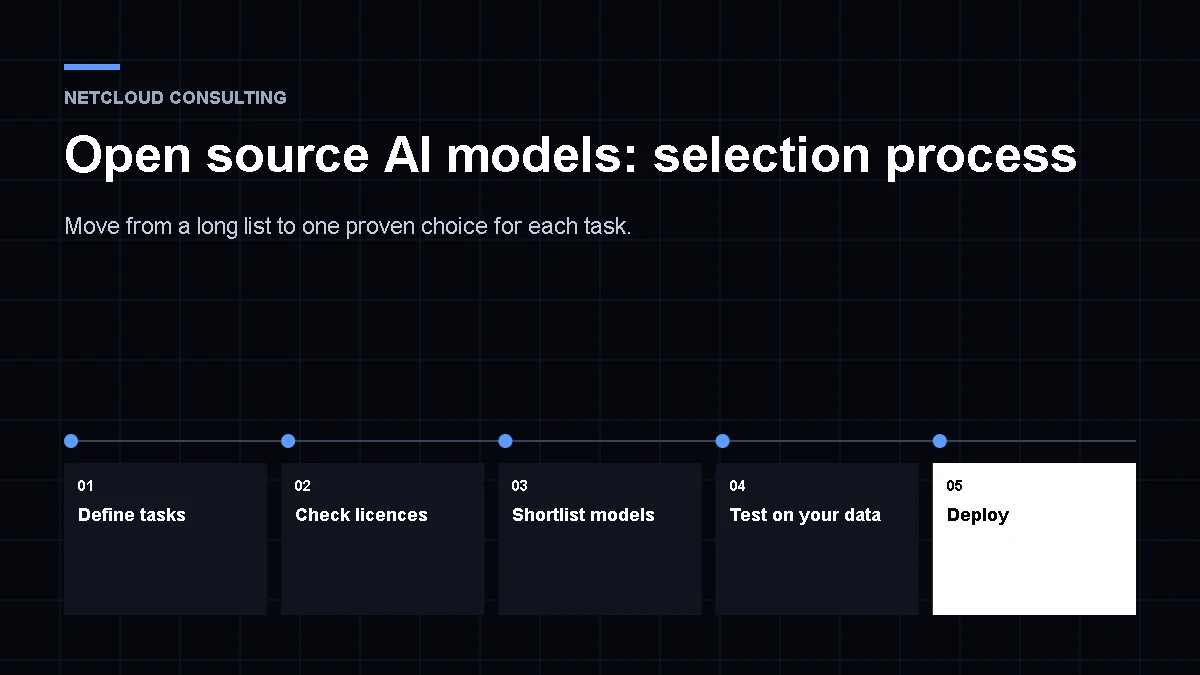
How we work with open source AI models
We focus on the performance and risk that apply to your task.
Licence review
Check model terms against your use case for your legal team to confirm.
Task-based benchmarks
Score candidates on your documents, languages, tools and output formats.
Multilingual testing
Test language quality directly, including English and Hindi, where this matters.
Fine-tuning assessment
Establish whether prompts and RAG are enough before investing in fine-tuning.
RAG infrastructure →Hosted deployment
Serve the chosen model with suitable capacity and monitoring.
Self-hosted LLMs →Upgrade process
Compare new versions against a saved test set before replacing anything.
Choosing between open model approaches
Prompt only
Best forWell-defined tasks with little private knowledge
Watch forQuality limits on specialist subjects
Open model with RAG
Best forAnswers based on your own documents
Watch forRetrieval quality must be tested
Fine-tuned model
Best forConsistent format, tone or specialist tasks
Watch forNeeds quality data and repeat evaluation
How we evaluate open source AI models
A saved test set makes each later model upgrade quicker and safer.
Requirements
Set tasks, languages and constraints.
Shortlist
Filter by licence, size and hardware.
Test set
Build examples from real work.
Score
Compare quality, speed and cost.
Decide
Choose, deploy and keep a fallback.
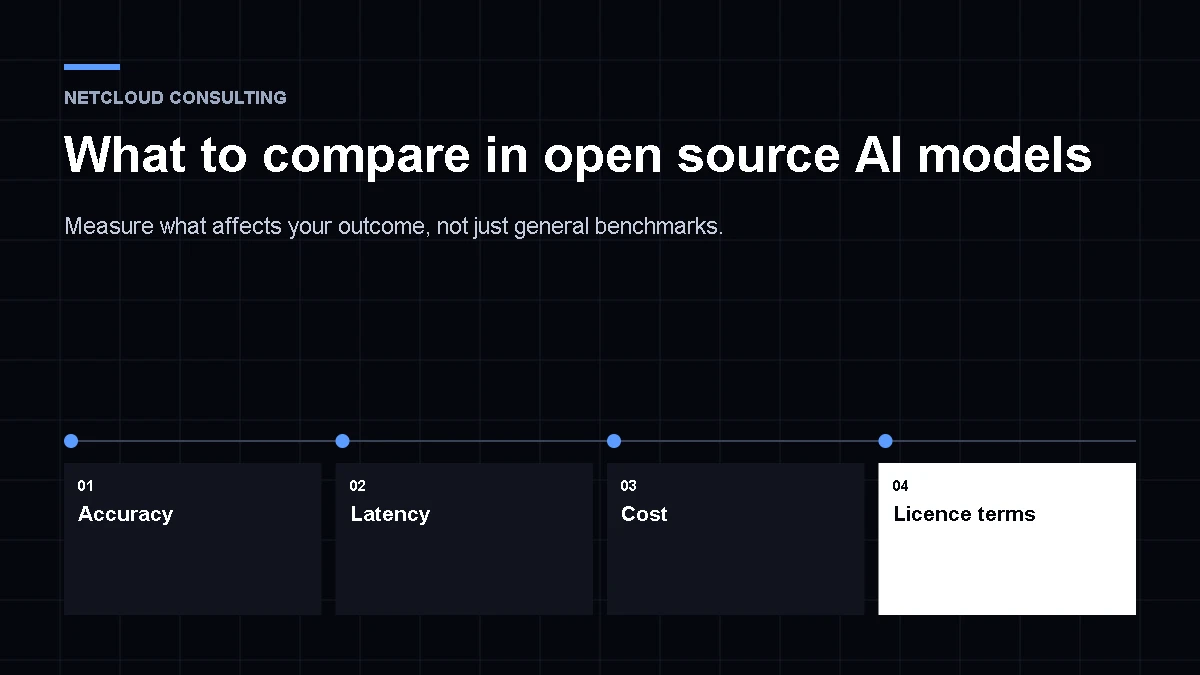
How to compare open source AI models
Read the licence first
Before any testing, confirm that the licence allows your use. Model terms vary, and some include conditions tied to use cases or company size. A quick early review by your legal team avoids building on open source AI models you cannot use commercially.
Test the languages you need
General benchmarks are usually dominated by English. If your customers use Hindi or other languages, test those directly with realistic questions. Quality can differ sharply between models that appear close on public leaderboards, particularly on mixed-language input.
Match model size to hardware
A larger model is not automatically better for your use. Smaller models can answer faster, cost less and handle focused tasks well, especially with good retrieval. Quantised versions reduce memory needs, though you should test whether quality remains acceptable.
Expect regular change
Open models improve quickly, so treat selection as a repeatable process rather than a one-time decision. A saved evaluation set and a standard serving interface let you test new releases in days, instead of rebuilding the application each time.
Official resources: Hugging Face model hub, Ollama model library and Meta Llama.
Open source AI model questions
Are open source AI models free for commercial use?
Not always. Download is usually free, but licence terms vary by model and version. Please have your legal team review the licence for your intended use.
Which open source model is best?
No model is best for every task. The right choice depends on your task, language, hardware and accuracy needs, which is why we test candidates on your own data.
Do open models match frontier models?
For many focused tasks they can be strong enough, particularly with good retrieval. Frontier models may still lead on the hardest reasoning, so hybrid routing can work well.
Do you need to fine-tune a model?
Often not. We usually try better prompts and retrieval first, because they are cheaper to run and easier to maintain.
Related AI infrastructure and services
Find the right open model
Bring a few real tasks, and we will show how shortlisted models perform on them.
Talk to our AI infrastructure team