
AI infrastructure you own, control and can scale
Netcloud Consulting designs and runs AI infrastructure for autonomous agents and enterprise applications: self-hosted LLMs, open source models, GPU capacity, voice, vector search and private deployment.
Book an architecture callSee the ARIA case study Ollama
 Hugging Face
 NVIDIA
 Qdrant
 Whisper
 Kubernetes
 Docker
What is AI infrastructure?
AI infrastructure is the combination of compute, models, data stores and operational tooling that runs AI systems in production. It decides how quickly agents respond, what they cost at volume and where your data travels.
Many organisations begin with a frontier API, which remains a strong choice for many jobs. Self-hosted AI infrastructure becomes attractive when data must stay private, usage is steady and high, or you want control over models and upgrades. Most production systems end up hybrid.
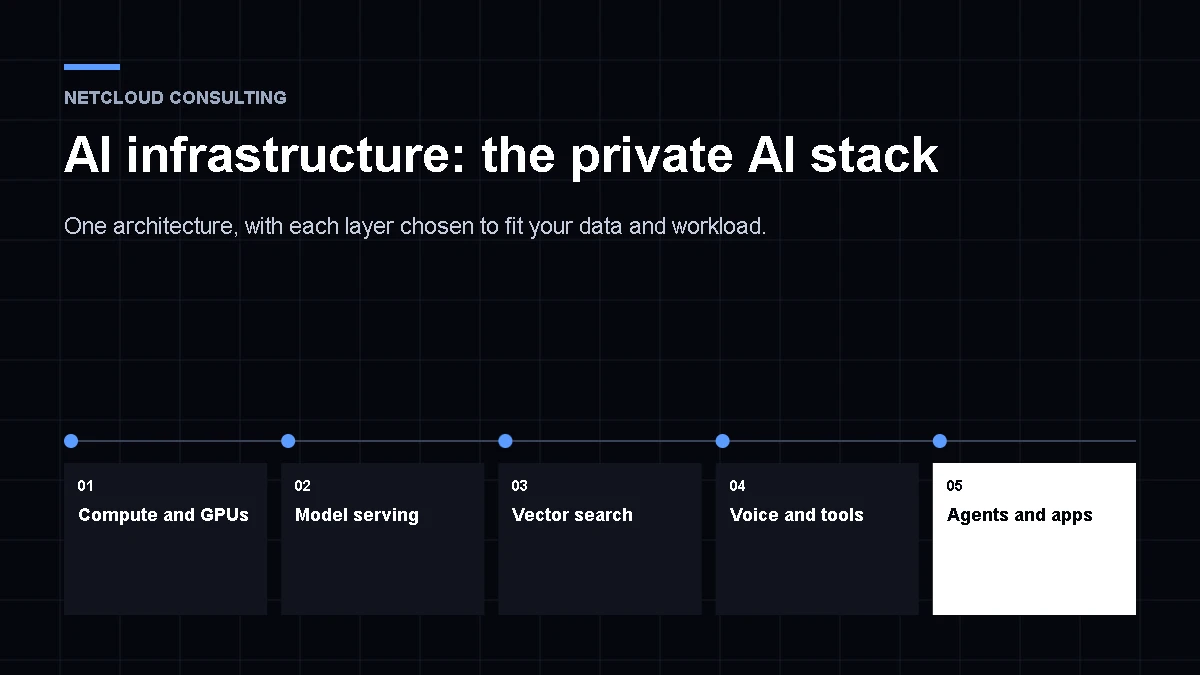
AI infrastructure services
Start with one layer or plan the full stack. Each service page explains when it fits and what to check.
Self-hosted LLMs
Run language models on your own or dedicated infrastructure with monitored serving.
Explore self-hosted LLMs →Open source AI models
Select, test and fine-tune open models against your real tasks and licence needs.
Compare open models →GPU infrastructure
Size, procure and operate GPU capacity for inference and training workloads.
Plan GPU infrastructure →Whisper and Kokoro voice stack
Self-hosted speech-to-text and text-to-speech for private voice AI.
See the voice stack →Qdrant vector database
Deploy and tune vector search with hybrid retrieval and metadata filtering.
Explore Qdrant →Private AI deployments
Keep AI workloads inside your network, cloud account or data centre.
Plan a private deployment →RAG infrastructure
Ingestion, embeddings, retrieval, evaluation and permissions for reliable answers.
Review RAG infrastructure →Frontier APIs, self-hosted or hybrid?
Frontier API
Best forFast starts, hard reasoning and variable workloads
Watch forPer-token cost at scale and vendor data terms
Self-hosted
Best forSensitive data, steady volume and full control
Watch forGPU costs, operations and model upgrades are yours
Hybrid
Best forRouting each task to the most suitable model
Watch forNeeds routing, evaluation and consistent governance
How we deliver AI infrastructure
The sequence stays the same whether you need one service or a full private AI platform.
Assess
Map workloads, data rules, volumes and latency targets.
Design
Choose models, hosting and retrieval, with a cost view.
Prove
Test candidates on your data and real questions.
Deploy
Automate rollout, access control and monitoring.
Operate
Track quality and cost, and plan upgrades.
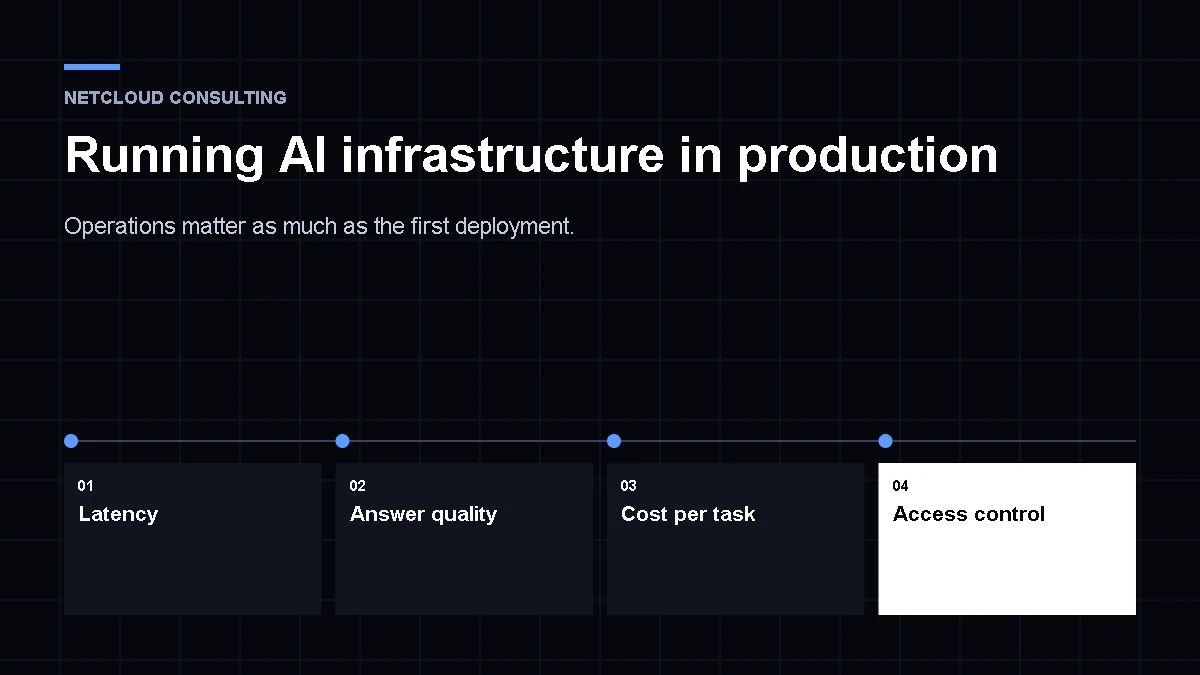
AI infrastructure buying guide: what to decide first
Start with the workload
Good AI infrastructure begins with the job it must do. An internal knowledge assistant, a customer-facing voice agent and a nightly document pipeline have very different needs for speed, availability and privacy. Write down expected users, response targets and data types before comparing products.
Decide where data can go
Data rules often settle the architecture. Some content can safely use a public API. Other content may need a dedicated cloud account or an internal network. Classifying your data first prevents a costly rebuild once security and legal teams review the project.
Plan for several models
Most organisations will not rely on one model for long. A gateway or routing layer lets applications switch between self-hosted and frontier models without code changes. That also makes upgrades, fallbacks and cost control much easier as better models appear.
Budget for operations
Hardware is only part of the cost of AI infrastructure. Include monitoring, security patches, model evaluation, backups and the people who look after them. A slightly simpler stack that your team can run confidently usually beats a sophisticated one that nobody can maintain.
Official resources: Ollama, vLLM documentation and Qdrant documentation.
AI infrastructure questions
What does AI infrastructure include?
It typically includes GPU or CPU compute, model serving, embedding and vector databases, speech services, orchestration, monitoring and security controls.
Do we need GPUs to run private AI?
Not always. Small models and embeddings can run on CPUs for light use. Interactive language models and voice at higher concurrency usually need GPUs. We size this against your workload.
Can we keep using OpenAI or Gemini?
Yes. Hybrid designs can keep sensitive or high-volume work on hosted models and send selected tasks to frontier models, as in our ARIA case study.
Do you have a live example?
Yes. ARIA is a voice AI tutor we built and manage using Qwen on Ollama, faster-whisper, Kokoro-82M and Qdrant on a private network.
Related AI infrastructure and services
Plan your AI infrastructure
Tell us about your workloads and data rules. We will recommend the simplest architecture that meets them.
Talk to our AI infrastructure team